

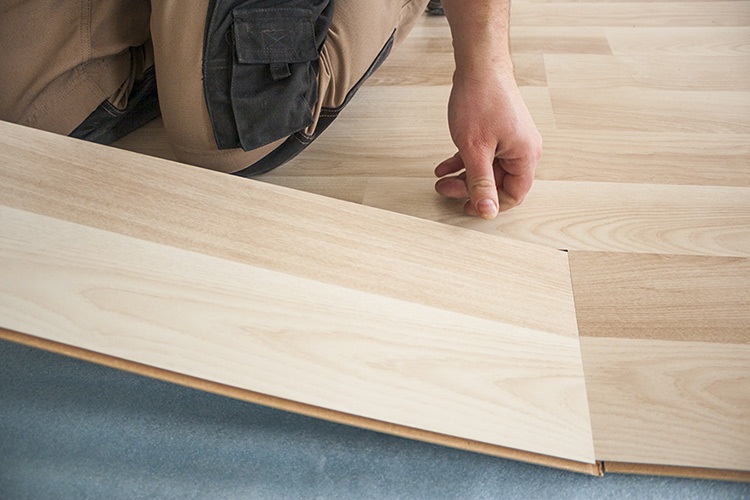
Laminate flooring has a quiet secret most homeowners never think about. It moves. Every plank in your home swells slightly when humidity rises and shrinks when the air turns dry, all without making a sound. This natural rhythm happens in every season, in every room, and it is completely normal for the material.
What keeps that invisible movement from becoming a visible problem is one small detail along the edges of the room: the expansion gap. Skip it during installation, and a beautiful floor can buckle, peak, or gap within months. We at Oklahoma Discount Flooring have proudly served families across Norman, Moore, Oklahoma City, Edmond, and Midwest City, helping them protect their investment through reliable flooring services and careful installation guidance.
Why laminate needs room to breathe
Laminate is a layered product made of compressed wood fiber, resin, and a tough wear surface. Those layers are sensitive to moisture and temperature, even though the finished plank looks solid and sealed. When the air shifts between humid summer afternoons and dry winter mornings, every board reacts. Unlike solid hardwood flooring, which is often nailed down and behaves differently, laminate floats freely over the subfloor and depends on perimeter space to move safely.
What an expansion gap actually does
Think of expansion gaps as breathing room for your floor. The gap itself is a deliberate, narrow space left between the edge of the floor and any fixed object, like a wall, doorframe, or cabinet base. It is tiny, usually hidden under baseboards or quarter round, and invisible from across the room.
When laminate expands, the planks push outward toward the perimeter. If there is open space along the wall, the floor simply slides into it and settles back when conditions change. If there is no space, the boards have nowhere to go but up against each other.
What goes wrong when gaps are skipped
The damage rarely shows up right away. It usually appears a few weeks or months after installation, once the seasons begin to shift. By then, the floor is already fighting against the walls, and the signs are unmistakable for a floor that should still look brand new.
The most common sign is peaking, where two planks press together and lift at the joint to form a small ridge across the room. A more dramatic version is buckling, where a whole section of floor rises off the subfloor in a wave shape. Homeowners often notice squeaking or popping first, and many later see wide gaps appear once the floor contracts and cannot return to its original spot.
These issues almost always require partial or full reinstallation, and many are not covered by manufacturer warranties when the gap was missed.
Best practices to remember for laminate
A few simple habits during planning and installation make all the difference. Whether you are working with our crew or planning your own project, these are the points worth remembering before the first plank goes down.
- Leave a gap of roughly one quarter to one half inch around the entire perimeter, including doorframes and pipes.
- Acclimate the planks in the installation room for at least 48 hours so the material matches your home's humidity before it is locked in.
- Use spacers during installation and remove them only after the last row is set in place.
- Cover the gap with baseboards or quarter round that rest against the wall, not on top of the floor, so the planks can keep moving freely.
- Avoid pinning the boards with heavy furniture pressed tight to the walls, since that can block natural expansion.
- In rooms where moisture is a real concern, such as bathrooms or basements, consider luxury vinyl flooring as a sturdier alternative.
Stop by our showroom and plan a floor that lasts
A floor installed with care lasts decades, not months. Come visit our flooring experts in person to look at samples, walk through your space, and leave with a plan you feel good about. Browse our full lineup of flooring products to start narrowing down the look you love.


